

| Search Type: Gematria Text | |
| Results Per Page: |
ADVANCED OPTIONS
| Search In: | All Selected Only |
| Chumash: | Bereishit Shemot Vayikra Bamidbar Devarim | Neviim: | Yehoshua Shoftim Shmuel I Shmuel II Melachim I Melachim II Yishayahu Yirmiyahu Yechezkiel Hosea Yoel Amos Ovadiah | Yonah Micha Nachum Chabakuk Zephania Chaggai Zechariah Malachai | Ketuvim: | Tehillim Mishlei Iyov Shir HaShirim Ruth Eicha Kohelet Esther Daniel Ezra Nechemia Divrei HaYamim I Divrei HaYamim II | SELECT ALL DESELECT ALL |
| Alphabet: | None | Atbash | Albam | |
| Gematria: | Absolute | Ordinal | Reduced | Extended Sofit Letters |
| Milui: | None | Milui | Milui b'Milui | Milui Before Substitution |
| | ||||
| Alphabet: | None | Atbash | Albam | |
| Gematria: | Absolute | Ordinal | Reduced | Extended Sofit Letters |
| Milui: | None | Milui | Milui b'Milui | Milui Before Substitution |
| | ||||
Ohr Chadash is excited to present to you an invaluable tool that will allow you to probe new depths in understanding Torah and its rich layers of meaning and how the world is intrinsically connected, ultimately leading to new and revealing insight.
One of the most important of the thirteen rules by which we interpret the Torah (found in the beginning section of the morning prayers) is gezerah shavah, which loosely translated means that similar words in different contexts are meant to clarify one another. This device is used literally hundreds of times in the Talmud to shed light on issues ranging from Jewish law, to the alluded, allegorical and mystical meaning of the text. Quite simply it is the way we “connect the dots” of Torah and life itself.
Through using this easy to use program you can type in a word in Hebrew and virtually instantaneously see written out all the places in theTanach, the 24 books of the Bible, where this word, name or phrase appears. By studying these appearances we begin to see connections we may have never seen before. Meanings on multiple levels begin to literally jump off the page.
Gematria, Jewish numerology, works according to the same principle. In Hebrew each letter has a numerical equivalent. According to Kabbalah, if two words or phrases share the same number, they are considered to possess some significant connection. Gematria reveals a deeper set of correspondences as seen in the literal text and points to an entire mathematical structure underlying the Torah. Similar to how physics and chemistry rest on a mathematical foundation, so too, deeper dimensions of Torah are revealed though gematria.
The Hebrew letters are explained to be the building blocks of creation. Similar to how a physicist or chemist would describe the world as consisting of atoms, particles, molecules and elements, the Jewish tradition describes this same function to the Hebrew letters. Although the language of science and Torah are different they are both describing the same reality.
Yet it is not Kabbalah alone which employs gematria. The Talmud and Rashi also use this technique of learning on occasion in order to point out a cogent idea, and it has been used as well by a wide range of commentators throughout the ages. In as much as Kabbalah seeks to make known the oneness of God and the interconnectedness of all reality, gematria assumes a major role in revealing this through the Torah text.
When the letters of a word are permutated they form other words that are intrinsically connected. An entire book, the Tikunei Zohar, explains the many permutations of the six letters of the first word of the Torah, bereishit, “in the beginning.” In doing so it reveals a profound understanding of the creation and the Divine creative process. This technique of permuting letters plays an important role in Kabbalistic wisdom. Alternative alphabets are similarly based on exchanging letters in an orderly manner, revealing deeper and more hidden aspects of the Torah.
The possibilities are nearly infinite and thanks to computer technology the ability to see graphically and instantaneously these “dots” are truly a wonder. Making the connections ourselves opens up a whole new level of understanding.
We invite you to not only use this program for free, but please share it with as many people you know who may enjoy this amazing tool.
Many thanks to David Komer, an Ohr Chadash alumnus, whose skill, ingenuity and persistence created this wonderful program.
Useful Information about Gematria
and Alternative Alphabets
GEMATRIA
Each of the twenty-two Hebrew letters has a numerical equivalent. The five letters that have a second, final form (when appearing at the end of the word) maintain in most cases the same numerical equivalent, although in certain instances these five letters have their own numerical value as well, as shown in the following chart of the absolute or normative value of the letters:
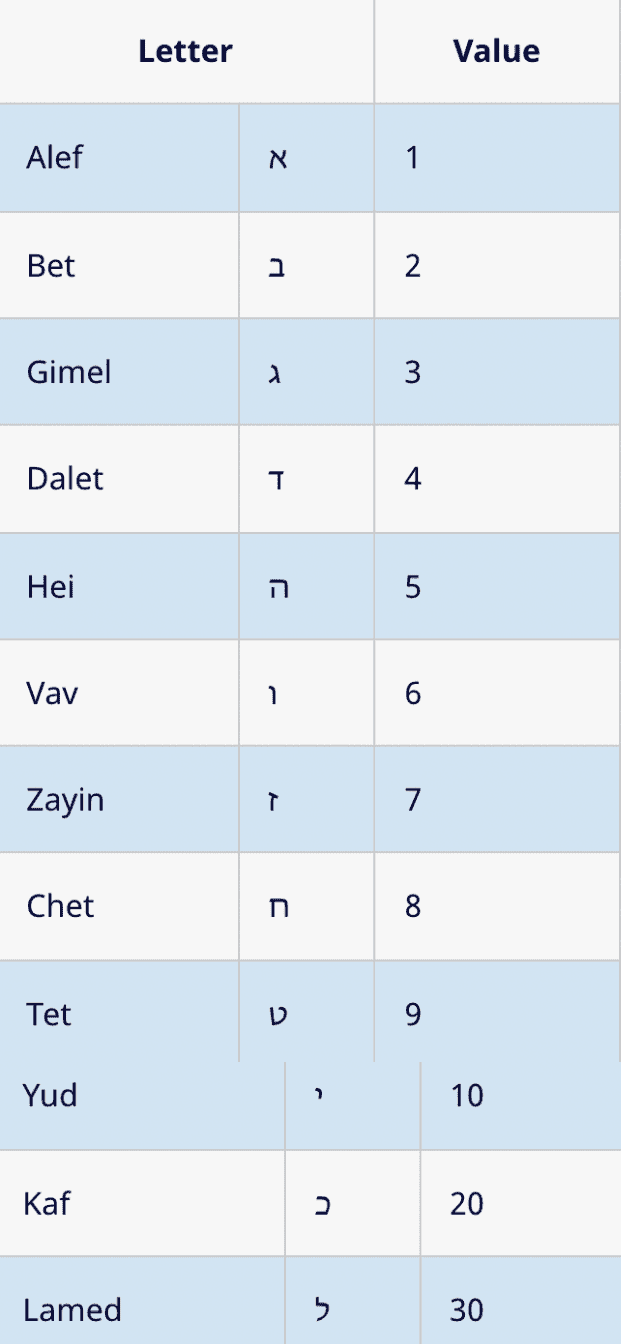
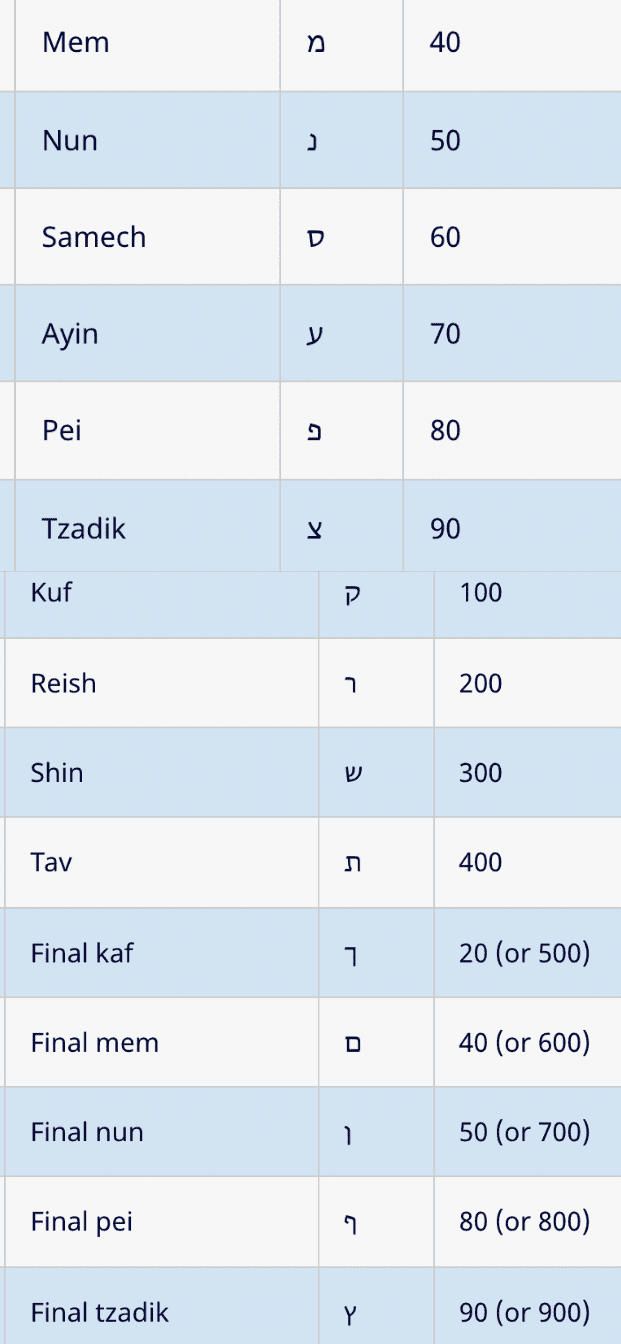
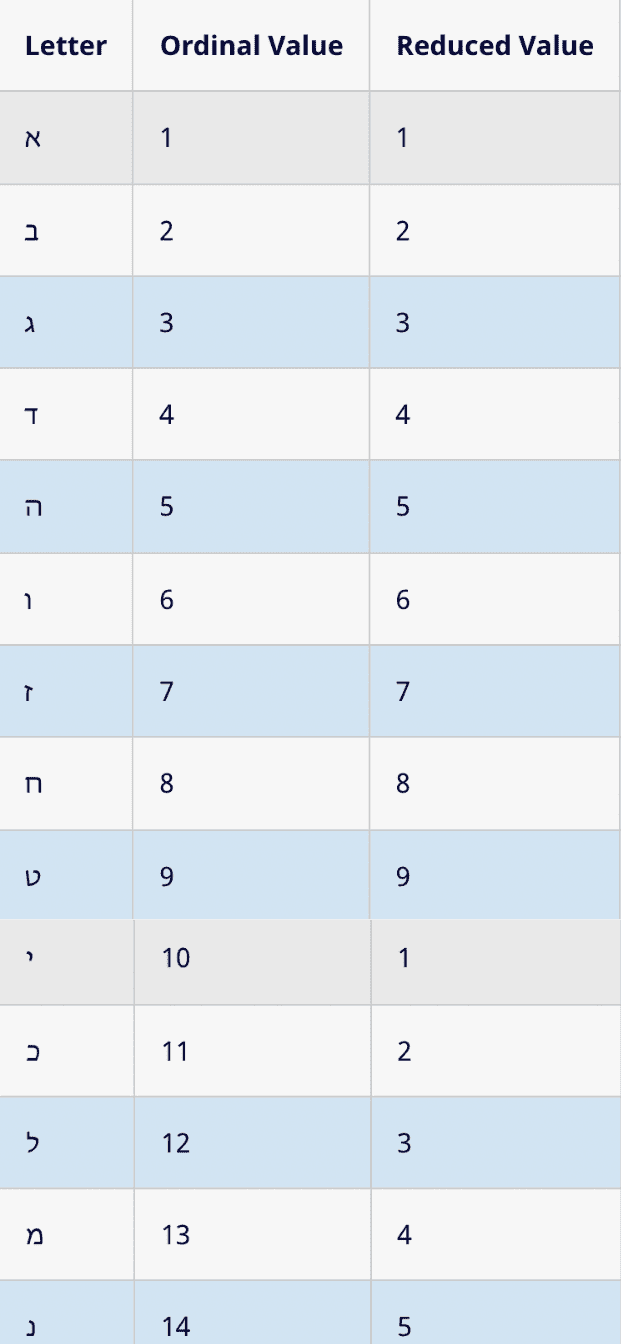
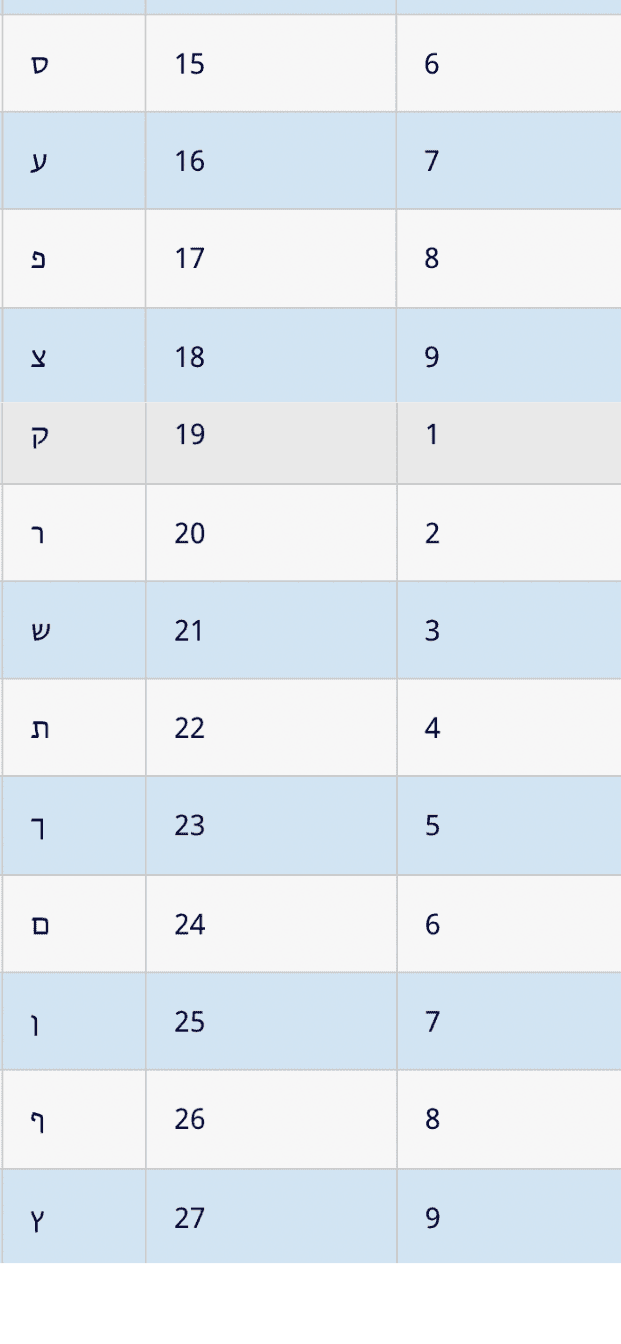
In addition to the absolute or normative value of the letters there are other systems of gematria, each emphasizing another dimension of the relationship between letters and numbers and the unique insight afforded when understanding these relationships. Along with the absolute value of the letters, the order of the letter in the progressive unfolding of the twenty-two letters also has great significance in Kabbalah. This is termed the ordinal value system where each letter is assigned a number from one to twenty-two (and in some cases to twenty-seven, when the final letters are considered on their own). Many of the Psalms, Shabbat songs and liturgical poetry used throughout the year are based on the progressive and orderly unfolding of the Hebrew alphabet.
Another form of gematria, termed the reduced value system, is based on the decimal system, where every letter of ten and above reduces to one digit, its numerical lowest common denominator. The fact that mathematics itself is based on the decimal system of ten is of course extremely important. The number ten is highly symbolic and significant in Torah and appears in virtually all manifestations of Jewish tradition.
ORDINAL AND REDUCED VALUE CHART
In all these different systems of gematria, novel and original meanings hidden in the words of the Torah are thus revealed. As in all matters of Torah these insights must conform to Jewish tradition and cannot be used to contradict or challenge Jewish law. The more one learns and is familiar with Torah the greater the insight born from the use of gematria.
ALTERNATIVE ALPHABETS
Similar to how different systems of gematria reveal deeper levels of understanding Torah and its hidden structures, there are along with the normative alphabet other alternative Kabbalistic alphabets that serves the same function. Through a logical sequence of exchanging letters these alphabets reveal inner dimensions of Torah not readily perceived.
The Atbash system is based on exchanging the first letter of the alphabet for the last letter, the second letter for the second last letter and so forth. This concept has many precedents in Jewish thought. In the Sefer Yetzirah it is stated that “the end is embedded in the beginning and the beginning in the end.” In the beloved song Lecha Dodi, sung on Friday nights in which we welcome the Shabbas bride, is included the words that Shabbat was “last in deed [yet] first in thought.” About God it is said “He is first and He is last.” In Kabbalah it is taught that the lowest point of one world becomes the highest point of the subsequent world. These are but a few of the many references to the connection between the beginning and the end.
The Albam system is similar to Atbash but in this structure of exchanging letters the alphabet is divided in half, eleven letters in each section. The first letter of the first series is exchanged for the first letter of the second series, the second letter of the first series for the second letter of the second series and so forth.
In the following chart read from right to left, the letter on the top line is exchanged for the letter appearing right below it.
ATBASH CHART
| כ | י | ט | ח | ז | ו | ה | ד | ג | ב | א |
| ל | מ | נ | ס | ע | פ | צ | ק | ר | ש | ת |
ALBAM CHART
| כ | י | ט | ח | ז | ו | ה | ד | ג | ב | א |
| ת | ש | ר | ק | צ | פ | ע | ס | נ | מ | ל |
Seeing the Torah through these various systems of gematria and alternative alphabets directs us to the awesome depths and rich levels of allusion hidden in every single letter, word, phrase and verse of the Torah. The possibilities are infinite for the Torah reflects the will of an infinite Creator. Our sincere desire is for those who use this program to experience the excitement and awe of touching Divine consciousness through delving into the Torah, as King David exclaimed: “Open my eyes that I may see wonders from Your Torah.”
MILUI
The word Milui means “filling”. This is one of the devices used in Kabbalah to explore deeper dimensions of Hebrew words. The great Kabbalist Rabbi Yitzchak Luria used this method extensively to reveal hidden meanings in the Torah text.
One finds the Milui of a Hebrew word by spelling it in its full form in the following manner. For example, the letter Aleph (א) is filled out by the three letters that make up the name of the letter: Aleph Lamed Peh (א ל פ).
The Milui of the Milui is found in the same way. Again using the letter Aleph as our example: Aleph Lamed Peh – Lamed Mem Daled – Peh Heh. The following chart shows this in Hebrew:
א
אלף
אלף למד פה
אלף למד פה למד מם דלת פה הה
When using Milui, the gematria of these “fuller” spellings is what reveals the deeper dimensions. This whole Kabbalistic device can be compared to putting an object under a microscope. Each power of magnification reveals new details and dimensions of the object.
INSTRUCTIONS
The Advanced Word and Gematria Search program runs inside of your web browser, and it is divided graphically into the following 4 sections:
- 1. Basic Options and Status Box
- 2. Advanced Options
- 3. Search Box
- 4. Letter Input Pad
- 5. Display box
1. Basic Options and Status Box
This is where you select your options and receive basic information about your search. The text at the top tells you the status of the program (for example- “Loading”), while the options allow you to change how the search operates (for example- “Gematria” or “Text”).
Whenever you change an option (other than the two “Display As” options), you need to click the search button to affect the results.
When you have completed a search, the Status Box will display basic information about the search, as well as “first”, “previous”, “next”, and “last” buttons to view the results.
Let’s take a deeper look at all the various options. The basic options which are presented when you first load the program are “Search Type”, “Display As” and “Results Per Page”
DISPLAY AS
These options affect the current display of results. Unlike other options, changing these does not require re-running the search, and you will see the change immediately.
1. Display As Gematria This will change the display to show the gematria value of the Tanach text
2. Display As Display Alphabet/Milui Substitutions This will change the display to show the substituted Tanach text (if you haven’t set any alphabet or milui substitutions, nothing will change)
If you have both checked, it will display the gematria value of the substituted Tanach text.
1. Gematria This sets the search to convert your input text to a Gematria value, and then compare this with the Gematria value of the Tanach text.
2. Text This sets the search to literally compare your input text to the text of the Tanach.
Set this value to the number of results to view per page. Remember, pages can be switched by using the “first”, “previous”, “next”, and “last” buttons in the Status Box. This only limits how many results are viewed on each page.
2. Advanced Options
Additionally, there are advanced options which allow you to set substitutions, different gematria systems, and more. Go ahead and click “Show Advanced Options” to reveal all available choices, and then continue reading here to learn about them all:
SUBSTITUTIONS
You have the options of applying different rendering filters, seperately, to both your input text and the Tanach text.
It is important to know that the two sets are independent from each other.
For example, you can search for the Ordinal gematria of your phrase, within the Absolute gematria value of the Tanach, by setting the Input Options to Ordinal and leaving the Tanach Options on Absolute.
Similarly, you can search for the Absolute gematria of your phrase, within the Ordinal gematria value of the Tanach, by leaving the Input Options on Absolute, and setting the Tanach Options to Ordinal.
You can also change the rendering options for both your text and the Tanach text to be matching (e.g. by setting both to Ordinal).
These rules apply as well for the alphabet, milui, and other substituttions
For example: Let’s consider the first verse of the Tanach:
בראשית ברא אלהים את השמים ואת הארץ
If we were to set the Tanach options to Atbash, then it will internally modify this verse to the following text, before comparing it to your input text:
שגתבמא שגת תכצמי תא צבימי פתא צתגה
Remember, to see the modified verse, you must check the “Display As Substitutions” option
For more explanation of what the different alphabet, gematria, and milui options mean, refer to the section on Useful Information about Gematria and Alternative Alphabets for more information.
Here you have options to search through any number of the books in Tanach. The default is all of the books. In order to select specific books, change to “Selected Only” and then you will have options to “Deselect all”, “Select All”, or enable your choice of books.
3. Search Box
Here is where you type your text to search for. You can either use a Hebrew-enabled keyboard, or you can use the on-screen “Letter Input Pad”. The “Search” button runs the search.
4. Letter Input Pad
The “Letter Input Pad” consists of the Hebrew Aleph-Bet, plus a space character (represented by an underscore) and a delete character (represented by an arrow). When you click on an item, it adds that character to the “Search Box.” In the case of “delete”, it will remove a character from the “Search Box.” All of these actions depend on the position of the cursor within the Search Box.
5. Display Box
The Display Box is where you will see the results of your search. On the top of each page you will see the text you have searched for, as well as its Gematria value. From there on, the pages will be filled with matches to your search.
A match consists of a header- which is the location of the verse in chapter:verse format, followed by the verse itself. The matching text is highlighted in red.
If any of the above instructions are not clear, we are certain that through just a few minutes of experimentation with the program, you will come to understand the various options available
Enjoy the program, and may Hashem bless you to bring more happiness, health, and holiness into the world by discovering your relationship with the Torah. Amen!
© Ohr Chadash/David Komer 2007-2022